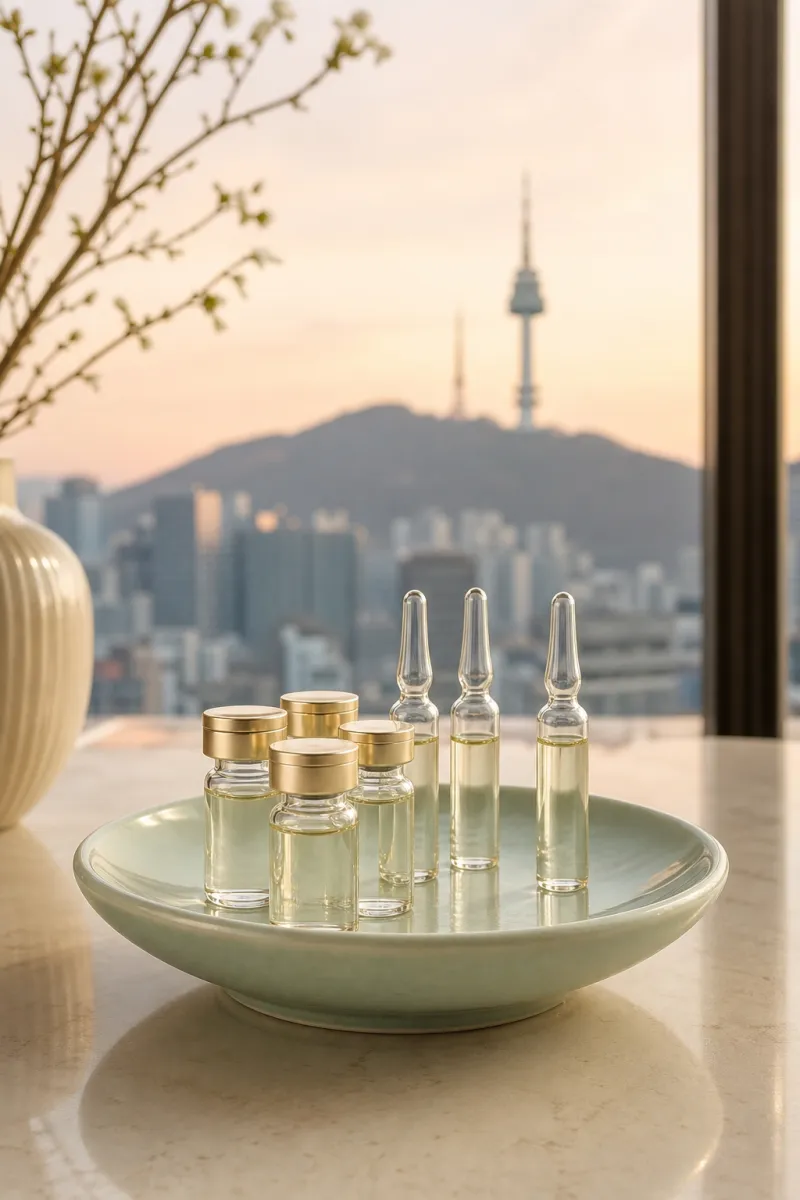
Exosomes in Korea are a topical add-on rather than a standalone treatment: a solution of tiny vesicles, usually derived from stem cell culture, is spread on the face once a laser, microneedling or a Potenza RF microneedling pass has created temporary openings, and the skin absorbs it during that visit. In Korea these products are classed as cosmetics, not approved drugs. Most of the redness comes from the device and usually settles within a few days, and flying home the same day is generally possible. Research looks promising for aging skin, scarring and pigment, but products and methods are not standardized yet. For visitors in Hongdae, the useful step is to ask what the add-on contributes before paying for it.
Guide
What the vial holds and how it reaches the skin
An exosome is a small particle released by cells that carries proteins, lipids and genetic messages to neighboring cells. Most products used on skin are made from the culture medium of human stem cells, although plant-derived and other sources also exist. In Korea they come as freeze-dried powder mixed with a diluent, or as a ready liquid, and they are applied on the surface; none is licensed as a medicine.
Surface application is why exosomes are always paired with a device. Microneedling, Potenza RF microneedling or a fractional laser opens short-lived channels, and the solution is spread over the face straight afterward. On intact skin it behaves much like any other serum, so the add-on changes the aftercare of a treatment you are already having rather than replacing it.
- Common pairings: microneedling, Potenza RF microneedling, fractional or pico laser
- Form: freeze-dried powder with a diluent, or a ready-mixed liquid
Guide
Where the evidence is encouraging and where it is thin
A 2025 review by Nahm and colleagues in the International Journal of Dermatology found clinical studies reporting benefits for skin aging, scarring, hair restoration and melasma, along with early work in inflammatory conditions such as atopic dermatitis. The same review described a fast-growing international market in which most formulations are derived from human stem cells.
The authors were just as direct about the gaps: isolation methods are not standardized, the cargo of each product needs proper characterization, and regulatory frameworks are unsettled. A study on one product says little about another brand, and when exosomes follow a device it is hard to separate their effect from the needling or laser.
Guide
Consent questions to raise before saying yes
A 2026 viewpoint by Mrigpuri in the International Journal of Dermatology looks at how doctors should counsel patients about exosomes, linking that conversation to evidence, regulation and informed consent. The practical takeaway for a patient is that an add-on with limited standardized data deserves a clear explanation from the treating doctor, not a sales line at the front desk. These questions cover the essentials.
- Product: the brand name, the maker, and whether the vial is opened in front of you
- Source: human stem cell culture, plant-derived or another origin
- Status: how the product is classified in Korea and where it is manufactured
- Role: what the add-on should change beyond the device session alone
- Method: how the solution is applied and what goes on the skin for the next few days
- Reaction: whom to contact if redness, itching or breakouts appear after you fly home
Guide
Planning the add-on around a stay in Hongdae
Because exosomes ride on a device session, the recovery to plan for belongs to the device. After microneedling or RF microneedling, redness and a tight, dry feel usually ease within a few days; after a fractional laser, fine crusting can last several days to a week. Choose a treatment day early in the trip, keep the next evening low-key, and skip saunas, pools and heavy sweating until the clinic says the skin has closed over.
Sun is the other factor. The streets around Hongik University invite hours of walking, so a hat and the sunscreen the clinic approves do more than any extra serum. Same-day flights are generally possible.
| Device the add-on follows | Usual look in the first days | Planning note |
|---|---|---|
| Microneedling | Pink skin and pinpoint marks for a day or so | A quiet first night, then normal plans |
| Potenza RF microneedling | Redness and mild swelling for a few days | Hold off on makeup until the clinic allows it |
| Fractional laser | Fine crusts for several days to a week | Book early in a longer stay |
Evidence
Research behind this page
- Exosomes in Dermatology: A Comprehensive Review of Current Applications, Clinical Evidence, and Future DirectionsInternational Journal of Dermatology · 2025 · doi:10.1111/ijd.17903
A review reporting clinical studies of exosomes in skin aging, scarring, hair restoration and melasma, while flagging unstandardized isolation, uncharacterized cargo and unsettled regulation.
- Counseling Patients on Exosomes in Aesthetic Dermatology: A Viewpoint on Evidence, Regulation, and ConsentInternational Journal of Dermatology · 2026 · doi:10.1111/ijd.70693
A viewpoint on how clinicians should counsel patients about aesthetic exosome products, framed around the current evidence, regulatory status and informed consent.
FAQ
Questions about Skin boosters in Hongdae
Is an exosome skin booster in Korea worth adding to a laser I already booked?
It may be, if you accept that the benefit is modest and less proven than the laser itself. An exosome skin booster in Korea is spread on the skin after the laser opens it, and studies suggest it may support recovery and texture, but products differ and standardized data are limited. Ask the doctor what change they expect from the add-on alone. If the answer is vague, the laser without it is still a complete treatment.
Can exosomes help red or brown marks left by old breakouts?
They may play a supporting role, but they are not the main treatment for post-acne marks. The 2025 review by Nahm and colleagues in the International Journal of Dermatology described clinical studies in scarring and melasma, which hints at some effect on texture and pigment alongside procedures. Red marks usually respond to vascular lasers or time, and brown marks to pigment care and sun protection. Treat exosomes as an extra on top of a plan that already targets the mark.
Does exosome care do anything without needling or a laser first?
On intact skin an exosome solution acts much like a well-made serum, because the outer skin layer keeps most large particles out. That is why clinics in Korea apply it right after a device has opened temporary channels. If someone offers exosomes as a standalone facial, ask what makes absorption possible there and what results they have actually seen in patients.
Can I wear makeup the day after an exosome session?
Usually not on the first day, and the clinic sets the exact wait based on the device used. After microneedling or RF microneedling the skin keeps tiny open channels for a short time, and makeup can irritate them or carry bacteria in. A lighter treatment may allow mineral makeup sooner than a fractional laser does. Pack a gentle cleanser and the moisturizer the clinic suggests, and plan a bare-faced day early in the trip.
How many exosome sessions make sense on a short trip?
One session is typical on a short trip, since the add-on follows a device treatment that needs its own recovery time. A full course is spaced over weeks because the skin has to heal between needling or laser sessions. Someone living in Seoul for longer can plan several visits with gaps between them. On a single visit, judge the effect by how smoothly the device session healed rather than by dramatic change.