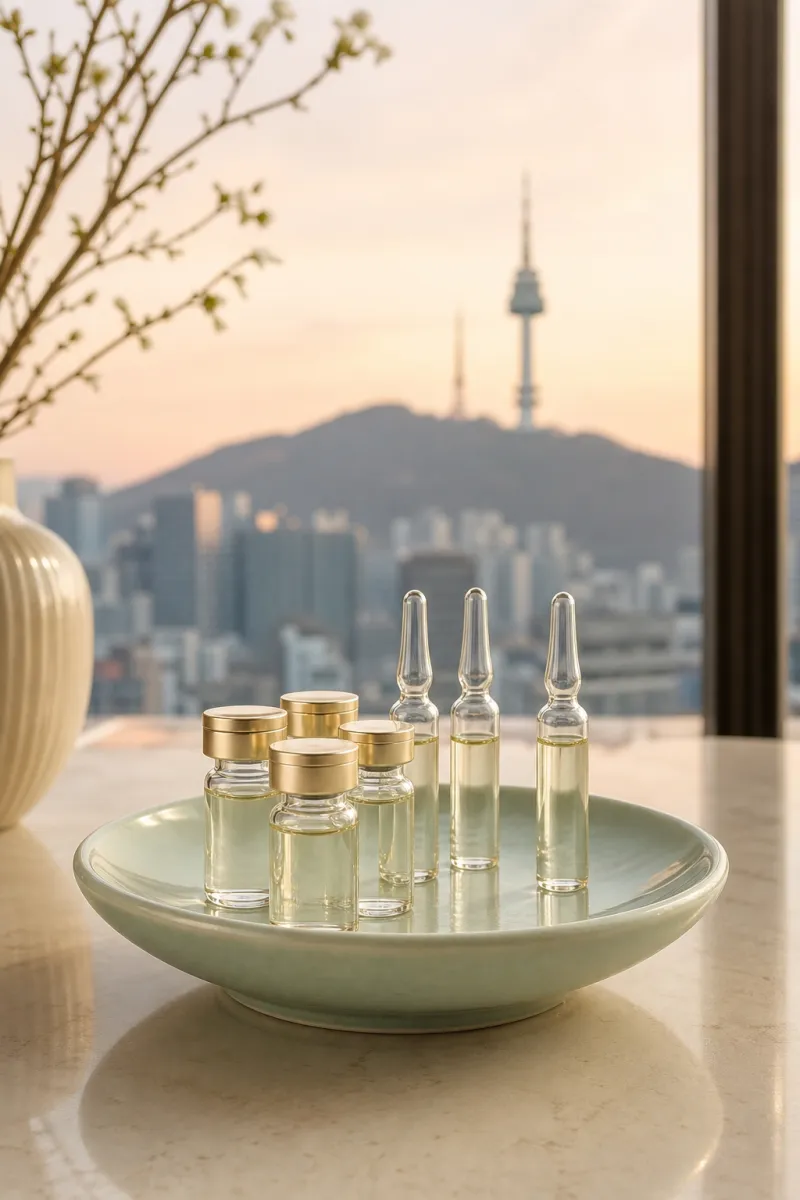
The exosome Korea price is rarely a stand-alone figure; it is an add-on charged on top of the skin-opening step it follows, such as Potenza RF microneedling, MTS or LDM. Clinics list it per session or per vial, and the add-on changes with the product brand and how much of the face is covered. Listed figures are before VAT, and 10% VAT is added at payment. For someone living near Hongdae for a semester or a working holiday, the practical questions are whether to pay visit by visit or prepay a series, and what the extra spend actually buys.
Guide
Pricing exosomes as an extra on top of a device session
Exosome solutions in Korea are classed as cosmetics, not approved medicines. The solution is spread over the skin straight after a device has made fine channels, and it is absorbed through them. That makes the exosome line an extra stacked on a session you could book on its own.
This split helps when money is tight. Ask the clinic to show the device session and the exosome add-on as separate figures. You can then see what the add-on costs per visit and decide whether to keep it for every session, use it once, or leave it out.
- Device step: Potenza RF microneedling, MTS or LDM, priced per session or per area
- Exosome add-on: priced per vial or per session, depending on the brand
- Area: face only, or face and neck, which can need more solution
- VAT: 10% added at payment on every line
Guide
Paying per visit or prepaying a series during a long stay
People staying in Seoul for months on a student or working-holiday visa can spread sessions out instead of squeezing them into one week. That changes the money question. A prepaid package often lowers the per-visit figure, but it ties the money to one clinic and one schedule.
Before prepaying, read the refund terms in writing. Ask what happens if you leave Korea earlier than planned, if your skin reacts and the doctor pauses the course, or if you want to move the remaining visits to a different treatment. Paying per visit costs more each time but keeps the choice open.
| Payment approach | Who it tends to suit | What to check first |
|---|---|---|
| Pay per visit | First-timers and short or uncertain stays | Whether the add-on can be dropped on later visits |
| Prepaid series | Residents with a fixed date to leave Korea | Refund terms, expiry date and transfer to other treatments |
| Add-on on selected visits only | Budget-minded visitors doing a device course | Whether the device figure changes without the add-on |
Guide
Extras that can push the total above the quote
Other extras often sit beside the add-on. Numbing cream, a calming mask after the device step and home-care products sold at the front desk may each be billed separately. Ask which of these the quote already covers, and decline any product you do not need.
Follow-up is the less obvious cost. A 2024 case series in Dermatological Reviews by Nahm and colleagues described seven women aged 26 to 37, most of them treated in South Korea, who developed red, firm lumps at the treated sites between two weeks and three months after exosome treatment. Biopsies showed granulomas, and responses to steroid creams, tablets and other care varied. Such reactions appear uncommon, but if one starts after you fly home, care there is a separate expense. Ask how the clinic handles review visits after your stay.
Guide
What the published evidence says the extra spend buys
A 2026 systematic review in Cureus by Flores Rodríguez and colleagues included 19 human studies of exosome-based skin treatments, most of them not randomized. The authors linked exosome use with short-term gains in hydration, elasticity, wrinkles, pores, pigmentation and overall appearance. Topical use was generally well tolerated, apart from individual reports of harm when products were used outside the topical route.
The review also points to mixed methods and short follow-up, so it cannot say how much exosomes add beyond the device step alone. For a visitor watching costs, that is the core point: the device session has its own effect, and the add-on is a smaller, less proven extra. Results vary from person to person.
Evidence
Research behind this page
- Efficacy of Exosome-Based Therapies for Skin Rejuvenation: A Systematic Review of Human StudiesCureus · 2026 · doi:10.7759/cureus.104182
Reviewed 19 mostly non-randomized human studies and found short-term skin quality gains, good topical tolerance and a need for rigorous trials with longer follow-up.
- Complications After Exosome Treatment for Aesthetic Skin RejuvenationDermatological Reviews · 2024 · doi:10.1002/der2.242
Described seven women who developed delayed granulomatous papules or nodules at treated sites two weeks to three months after exosome treatment.
FAQ
Questions about Skin boosters in Hongdae
Can I book the microneedling session without the exosome add-on?
Yes, in most clinics the device step can be booked on its own, and the exosome solution is an optional extra. Potenza RF microneedling, MTS and LDM each have their own effect on the skin. Ask for both versions of the quote so you can see what the add-on costs per visit, then decide separately for each visit you book.
Is the exosome add-on worth it for skin in your early twenties?
For most people in their early twenties it is optional, because the evidence for topical exosomes comes from small, short studies. Younger skin often responds well to the device step and careful aftercare alone. If uneven texture is the concern, ask the doctor which part of the plan targets it. Fewer, well-planned sessions usually stretch a student budget further than extras added to every visit.
Can I bring my own exosome product from a shop to the clinic?
Most clinics will not apply a product brought in by a patient, because they cannot confirm how it was stored or what it contains. Many clinic products are freeze-dried powders mixed with a diluent just before use. Ask to see the box, brand and batch of the product the clinic applies. A shop product meant for daily skincare is not designed for freshly needled skin.
Does an exosome serum at home give the same result as the clinic session?
No comparison study shows that, and the two are used differently. In clinic, the solution goes on right after a device opens fine channels, which helps it pass the surface layer. A home serum sits on intact skin. The 2026 Cureus review by Flores Rodríguez and colleagues found mostly short-term, non-randomized evidence for exosome treatments, so claims for either route deserve caution.
Is 10% VAT charged on the exosome line as well as the device step?
Yes. Listed figures are before VAT, and 10% VAT is added at payment to every line on the bill, including the add-on, numbing cream and any home-care products. When comparing two quotes, check that both are written the same way. Budget for the VAT-added total from the start, so the amount at the front desk does not come as a surprise.
Why do some clinics not offer exosome care at all?
Exosome care is an optional cosmetic add-on, and each clinic decides which products to stock. Some prefer to pair device sessions with other boosters or plain soothing care. A menu without exosomes says little about how the device work is done. If you specifically want the add-on, ask before booking which brand the clinic uses so you can look it up first.